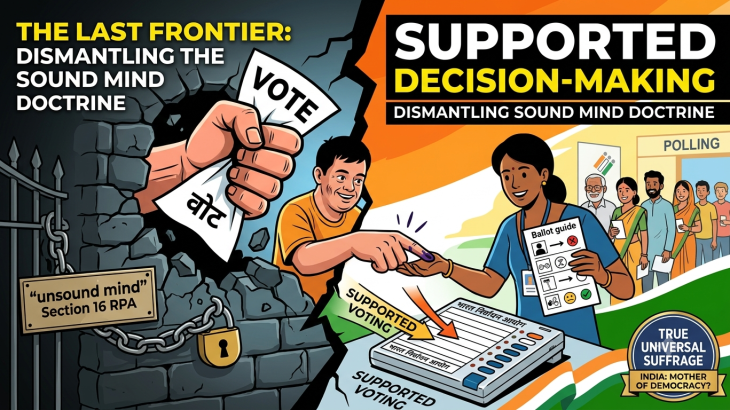
The author of this essay is Rangoli Singh (2nd year student from Himachal Pradesh National Law University, Shimla). ADR collaborated with the Centre for Human Rights and Disability Studies (CHRDS), Himachal Pradesh National Law University, Shimla, for the National Article Writing Competition on “Electoral Rights of Persons with Disabilities”. This essay has been published under this collaboration. This essay won the first prize.
I. INTRODUCTION
Every five years, India conducts the world’s largest exercise in democratic logistics, often celebrated as the “Festival of Democracy,” which is marked by long queues, ink-stained fingers, civic engagement, and high voter turnout. However, behind the facade of democracy, the reality of “civil death” exists for many Indian citizens. The right to vote (universal adult franchise), guaranteed by Article 326[1] of the Constitution of India for all citizens, is a sham for those deemed “unfit” to vote due to an antiquated test of “unsound mind” under Section 16 of the RPA, 1950[2]. This colonial relic disqualifies people from being able to vote based upon a pathological (medical) conception of mental disability rather than a “fundamental rights” conception of disability.
This article argues that the present electoral system is based on a false dichotomy of “capacity,” which fails to account for the jurisprudential shift towards Reasonable Accommodation. By invoking Articles 143 (Equality) and 214 (Dignity), this article aims to shift focus from “Substituted Decision-Making”, where the guardian decides on behalf of the person, to “Supported Voting”, where the person is aided to decide for themselves. To be a true “Mother of Democracy,” India must remember that the right to vote is not dependent on a citizen’s mental perfection, but on the inherent dignity of being a part of the sovereign.
II. THE SOCIO-LEGAL IMPACT OF ‘CIVIL DEATH’
In the philosophy of law, the concept of “Civil Death” (or civiliter mortuus) refers to the legally sanctioned removal of the political and legal personality of a person.[3] When Section 16 of the RPA 19506 refers to the “unsound mind” rule, it is more than just excluding a person from entering a polling booth; it is a psychological banishment from the national body.
The existing legal system is based on the Medical Model of Disability, which views the person as “broken” or “deficient.” This approach forms a feedback loop of social stigma. Since the State holds a citizen to be unfit to vote, it also upholds the social prejudice that people with intellectual and psychosocial disabilities do not have agency, moral capacity, and the right to self-determination.
This leads to what philosopher Miranda Fricker terms “Epistemic Injustice”.[4] In this case, it is the denial of the disabled person’s capacity as a “knower” and a “participant.” This marginalisation ensures that their particular needs, from inclusive education to accessible healthcare, are never given priority in the political agenda. Since they are not considered a “voter bank,” they become invisible to the political class, which creates a cycle of systemic neglect that further marginalises them.
III. THE DATA GAP: AN EMPIRICAL ANALYSIS
Transparency is the foundation of electoral integrity. Yet transparency is impossible without data that is not intentionally concealed under the guise of general legal terms.
- The Participation Gap: In the 2024 General Elections, while the overall voter turnout in the 2024 General Elections was approximately 65.79%, there is a significant “Participation Gap” for PwDs.[5] The Election Commission of India (ECI) reported that more than 88.4 lakh voters with disabilities (PwDs) were registered to vote.[6] Yet the reality is that a “Participation Gap” exists. For instance, while physical infrastructure has improved to include ramps and braille signs, the data on voters with intellectual disabilities is statistically invisible. These voters are “Ghost Constituents”, statistically recognised but politically voiceless.
- The Failure of Physical Centricity: The “Home Voting” facility, a landmark move by the Indian electoral system in the 2024 elections, was a boon for elderly citizens or individuals facing physical disabilities.[7] However, it did not take into consideration the issue of Cognitive Barriers. For a voter with intellectual disabilities, the barrier is not the distance of the booth, but rather the intricacies of the voting system itself. Without a legally recognised “Support Person” to help, rather than hinder, their vote, this facility is still a step behind for a section of the disabled community.
IV. THE TECHNICAL CRITIQUE: THE ‘SAKSHAM’ PARADOX AND THE ACCESSIBILITY CEILING
The Saksham App, designed by the Election Commission of India, has been hailed as a technological marvel in promoting inclusion in elections.[8] But, beneath this facade of technological advancement, there is the ‘Accessibility Ceiling,’ beyond which technology ends, and exclusion starts.
1. The Cognitive Void
The Saksham App has done an exemplary job on the ‘hardware’ of disability, including requests for wheelchairs, transport, etc. But, on the ‘software’ of decision-making, the Saksham App has been deafeningly quiet. There has been no provision for ‘Easy to Read’ versions of the manifesto, or even audio-visual aids. Does it presume that the electorate can read the manifesto, or has it presumed that the electorate is neurotypical?
2. The Digital Divide and the Fallacy of High-Tech
There is a Digital Divide created by a complete lack of grounding in “Universal Design” principles, which ensures a new frontier of disenfranchisement. For Persons with Disabilities (PwDs), the complex maze of smartphone interfaces is as daunting a barrier as a physical staircase. When a system demands a certain level of precision or knowledge, it is no longer empowering but a barrier to entry.
3. Algorithmic Bias: The New Gatekeeper
As India embarks upon a new path of AI-based voter verification, there is a hidden threat of “Automated Exclusion.” Biometric authentication is based upon “normative” physical parameters. If a voter presents with symptoms such as tremors, skin conditions, or abnormal facial features, the system will flag them as a mismatch because it is not aware of human diversity. This is not prejudice but bias, locking out PwDs from Digital Democracy.
V. JURISPRUDENTIAL DEEP-DIVE: THE ‘VIKASH KUMAR’ SHIFT AND THE NEW EQUALITY
The Supreme Court’s decision in Vikash Kumar v. UPSC (2021)[9] provided a road map for reforming the overall electoral system. In that decision, Justice D.Y. Chandrachud provided a new framework for interpreting laws regarding persons with disabilities in India. According to the Supreme Court, reasonable accommodation is not merely a matter of charity or ex gratia, but a fundamental principle of equality and non-discrimination within the meaning of Article 14 of the Constitution of India. The Supreme Court’s decision is crucial because it marks a shift in how courts interpret the law. The fundamental rationale for the Rights of Persons with Disabilities Act, 2016, is the principles of equality and non-discrimination. Section 3[10] of the act provides an affirmative declaration of this intention, i.e., equality and non-discrimination for persons with disabilities, without imposing a benchmark disability. The previously disqualified voter, who was deemed to be of “unsound mind” due to a lack of accommodation, now represents a broader societal issue rather than an individual issue in which the State failed in its duty to provide reasonable accommodation for the individual.
Before Vikash Kumar, Indian law operated under a primarily medical model of disability. It looked at disability as a form of pathology (something that can be corrected) or as a limitation for the person with the disability. Under the previous model, Section 16 of the RPA was considered the only logical way to govern issues related to cognitive capability (to provide access to care for those who are unable to provide the required level of service because their minds are either unsound or have not developed sufficiently). This view was drastically changed when the Supreme Court adopted the Social Model of Disability, as laid out by Justice Chandrachud, who explained that “disability is created by the relationship of the individual with the environment.” The Court’s reading of Article 14 produces an irreconcilable tension with the present disqualification provisions in the RPA. If the State is constitutionally bound to make “accommodations” to guarantee equality, then a wholesale disqualification of voters with intellectual disabilities without first extending them “support systems” is prima facie unconstitutional.
The court’s rejection of the medicalised approach toward assisting others in making decisions has created a space to develop the concept of cognitive liberty. According to cognitive liberty, it is not the state’s role to judge how a person thinks; rather, it is the state’s role to create “bridges to the ballot” for there to be a transition from substituted decision-making (when a state has deemed a person incapable of making rational thought) to supported decision-making (when an individual can use pictorial ballot assistance and helpers to show their specific vote).
In the end, the Vikash Kumar shift requires us to realise that Section 16 of the RPA has ceased being a protector of the ‘voter’s intelligence’ and has become an unconstitutional impediment to dignity. It requires us to change from the era of ‘civil death’ to a democracy in which every citizen, no matter what their ‘mental mould,’ has the right to be seen, heard, and counted.[11]
VI. GLOBAL STANDARDS
Across the globe, the transition from the restrictive system of guardianship to the system of supported voting is no longer regarded as a radical experiment of progressive politics. Still, it has solidified as an obligatory international standard for protecting fundamental human rights. This change marks the death of the “perfectionist” model of democracy and its replacement with one that honours the diversity of the human mind.
1. The Nordic and North American Precedents: The Right to be “Wrong”
Countries such as Sweden and Canada have long remained at the forefront of this movement through legislative policies that have successfully separated the concepts of legal capacity and the right to vote. In the landmark case of Sauvé v. Canada (2002)[12], the Supreme Court of Canada delivered a devastating blow to the “rationality” test for voting. The Supreme Court reminded the world community that the “right to be wrong” is as important as the right to be right. By allowing citizens under guardianship to vote, Canada recognised that a voter’s choice need not be “rational” or “intellectually defensible” in the eyes of the State to be valid. It is a judgment that holds that a vote is a manifestation of subjective dignity rather than a manifestation of objective rationality. Sweden, too, has successfully eliminated the concept of legal guardianship, which denies citizens their civil rights. Instead, they have successfully introduced the idea of “mentors” or “god man.”
2. The UK and Australia: The “Easy-to-Read” Revolution
In both Australia and the United Kingdom, there has been a shift from legalising voting to ensuring access to information about voting. The electoral commissions from Australia and the United Kingdom have assumed a leading role in developing “Easy To Read” (EtR) standards. An EtR uses standardised pictograms and visual aids (also called “examples”) in the manifestos of political parties. This is the direct implementation of Universal Design principles and does not use technical or complicated language to exclude citizens with intellectual disabilities. Protecting the Cognitive Liberty of citizens in both nations means that citizens with varying cognitive processing abilities (e.g., Down Syndrome, Autism, Dementia) can navigate the political arena and do so without the challenges posed by the language elite use to exclude them from participating. An example of this would be a manifesto for the election of a new Prime Minister that a citizen cannot read. If this happened, the citizen is NOT at fault for not being able to read it; the political party that wrote the manifesto would be at fault for using ‘inaccessible’ language or words for the country’s citizens.
3. The Mandate of Article 12 and the CRPD Committee
This international trend has been informed by Article 12 of the United Nations
Convention on the Rights of Persons with Disabilities (UNCRPD), which stipulates that PwDs must enjoy legal capacity on an equal basis with other individuals in all spheres of life.[13] The UN Committee also reinforced this in the context of the Rights of Persons with Disabilities, which, through General Comment No. 1, asserted that “the ability of the person to make decisions cannot be used as grounds for excluding him or her from participation in political life.”[14] This was also reinforced by the European Court of Human Rights, which, through the case of Alajos Kiss v. Hungary (2010)[15], asserted that “the restriction of voting rights of those under guardianship without an individual assessment of their capacity constitutes a violation of Article 319 of the European Convention on Human Rights.” This argument, therefore, points to the fact that mental capacity is not fixed but can be improved. In contrast, legal capacity is an unalienable right.
VII. THE BLUEPRINT: A TRIPARTITE POLICY FRAMEWORK
To go beyond tokenism and achieve transformation, what is needed in India is a “Supported Voting Protocol.” A three-fold structural reform agenda will underpin this:
1. Legislative Amendment: The “Presumption of Capacity”
The pejorative term “unsound mind” must be eliminated from the RPA 1950. In its place, there needs to be a “Presumption of Capacity.” Disqualification of any voter must not be automatic but rather a direct result of a judicial determination, supported by evidence, that a voter, despite all support being provided, is not capable of expressing a preference.
2. The Support Mechanism: The Amendment of Rule 49N
India needs to amend Rule 49N of the Conduct of Elections Rules[16], which only permits assistance to the “blind or infirm.” This rule needs to be expanded to allow a “Support Person” for voters with cognitive disabilities. However, to prevent coercion, this support person will be under the supervision of a “Neutral Observer,” so that only the voter’s intent is heard.
3. Universal Ballot Design: The Pictographic Revolution
ECI should adopt Pictographic Ballots. Symbols and audio cues on the EVMs would enable voters with different cognitive abilities to recognise their candidate independently. In addition, the Association of Democratic Reforms should take the lead in auditing the manifestos of the political parties, ensuring they are “Easy-to-Read” so the “informed” in “informed consent” applies universally.
VIII. CONCLUSION: A CALL TO CONSTITUTIONAL MORALITY
This article essentially calls for a shift from procedural democracy, i.e. mechanical voting, to cognitive democracy, i.e., the inclusion of all minds, regardless of perceived “rationality” according to neurotypical standards. Democracy is measured by the expression of voice rather than a count of those with capabilities. The sound mind philosophy is a colonial-era cornerstone that must be crushed before we can achieve universal suffrage. The measurement of democracy will not be the number of new voters gained before the one hundredth anniversary of our freedom, but who and how many will be part of those who can vote. We need to get to the point where we are no longer measuring the accessibility of a ramp to the ballot box; instead, we need to look at how accessible we are to the way in which an individual thinks. Static movement toward change will only lead to tokenism. Instead, there must be a movement toward transformation to gain citizenship rather than putting someone in a position of higher authority or guardianship. A society that keeps out its weakest citizens is not a democracy; it is a gatekeeper. True suffrage is not a test of the mind, but a right of the person.
[1] INDIA CONST. art. 326.
[2] Representation of the People Act, 1950, § 16, No. 43, Acts of Parliament, 1950 (India). 3 INDIA CONST. art. 14. 4 INDIA CONST. art. 21.
[3] Harry David Saunders, Civil Death – A New Look at an Ancient Doctrine, 11 Wm. & Mary L. Rev. 988 (1970), https://scholarship.law.wm.edu/cgi/viewcontent.cgi?article=2837&context=wmlr. 6 Representation of the People Act, 1950, § 16.
[4] Miranda Fricker, EPISTEMIC INJUSTICE: POWER AND THE ETHICS OF KNOWING (Oxford Univ.
Press 2007).
[5] Election Commission of India, Press Note No. ECI/PN/116/2024, 65.79% Voter Turnout Recorded at Polling Stations in GE 2024 (June 6, 2024), https://elections24.eci.gov.in/docs/BnS4hhbvK9.pdf.
[6] Association for Democratic Reforms, ANALYSIS OF VOTER TURNOUT AND PWD PARTICIPATION IN GENERAL ELECTIONS 2024 (Association for Democratic Reforms 2024).
[7] Press Information Bureau (Govt. of India), Home Voting for Eligible Voters Extended Pan India for the First
Time in General Elections 2024 (May 29, 2024), https://www.pib.gov.in/PressReleasePage.aspx?PRID=2022053®=3&lang=2.
[8] Election Commission of India, Saksham App, https://www.eci.gov.in/saksham–app/ (accessed Feb. 1, 2026).
[9] Vikash Kumar v. Union Pub. Serv. Comm’n, 2021 SCC OnLine SC 84 (India).
[10] Rights of Persons with Disabilities Act, 2016, § 3, No. 49, Acts of Parliament, 2016 (India).
[11] Manav, Critical Analysis: Vikash Kumar v. Union Public Service Commission, 1 J. LEGAL RES. & JURIDICAL SCI. 323.
[12] Sauvé v. Canada (Chief Electoral Officer), [2002] 3 S.C.R. 519 (Can.).
[13] G.A. Res. 61/106, Convention on the Rights of Persons with Disabilities (Dec. 13, 2006).
[14] Committee on the Rights of Persons with Disabilities, General Comment No. 1 (2014) on Article 12: Equal Recognition before the Law, UN Doc. CRPD/C/GC/1 (19 May 2014), https://docs.un.org/en/CRPD/C/GC/1.
[15] Alajos Kiss v. Hungary, App. No. 38832/06, Eur. Ct. H.R. (2010). 19 European Convention on Human Rights art. 3 (1950).
[16] Conduct of Elections Rules, 1961, r. 49N, issued under the Representation of the People Act, 1951, Acts of Parliament, 1951 (India).