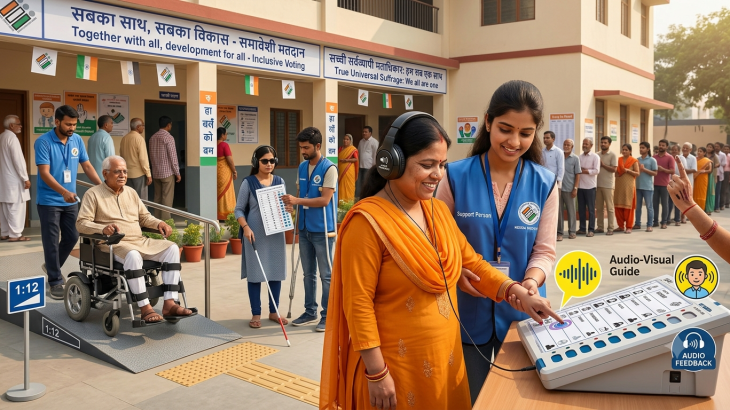
The authors of this essay are Ananya Singh and Divyansh Gera (2nd year students from Maharaja Surajmal Institute, New Delhi). ADR collaborated with the Centre for Human Rights and Disability Studies (CHRDS), Himachal Pradesh National Law University, Shimla, for the National Article Writing Competition on “Electoral Rights of Persons with Disabilities”. This essay has been published under this collaboration. This essay won the second prize.
Abstract
“The true test of universal adult suffrage lies not in who is allowed to vote, but in who is actually able to do so.” Right to vote, also known as suffrage ,is the constitutional right provided to every citizen of India who attains the age of eighteen years, under Articles 326 to 329. Though the Right to vote is not a fundamental right but is a constitutional right that forms the backbone of democratic governance. Persons with disabilities are also provided with the right to vote and provisions and procedures are provided for them so they have equal rights just as other citizens. Voters who have one of the 21 disabilities specified in the RPwD Act 2016 are referred to as “Voters with Disabilities”.
However to bridge the gap between who is “being allowed” and “being able” we must look forward to the Rights of Persons with disabilities (RPwD) Act, 2016. This article focuses on the contemporary evolution of this right within the framework of RPwD Act 2016, specifically section 11 which compels an accessible electoral process for every citizen. As India is moving towards a digital democracy, the electronic voting machines(EVMs) and the Voter Verifiable Paper Audit Trail (VVPAT) and digital voter portals serve as a double-edged sword. This study delves into the dichotomy between the digital democracy and digital divide.
On one hand, technology offers a legal promise of independence, which is supported by the RPwD Act, 2016.” by giving it more strength, legal backing and instructions. This legal promise of technology has indeed provided independent participation of PwDs in voting through brailled enabled EVM machines, digital portals and provisions like bringing a trustworthy person to help them. On the other hand there are the technical perils of the current system which reveals a widening divide as well. The study analyzes the verification paradox that has been created by the VVPAT slips which are only visual, this restricts the visually paired voters to independently verify their votes. Furthermore it also criticizes the reliance on rule 49N of the conduct of election rules 1961 which generally states that a disabled voter can take a companion with them for assistance. This effectively strips off the constitutional right of secret ballot of the PwDs. Ultimately this article argues that for suffrage to be truly universal, our digital evolution must give importance to universal design over mere convenience to ensure that the true test of democracy is met for every citizen regardless of their physical or sensory abilities.
Introduction
On the day of general elections Indian news channels are flooded with pictures of “inked fingers” which is considered as a proud symbol of an Indian citizen’s power in the world’s largest democracy. Under article 326 to 329 we have been told that every voice is equal and every vote is secret, but for nearly 2.68 crore Indians living with disabilities, that inked finger comes with a heavy price, i.e the sacrifice of their privacy and independence. We are often reminded that “the true test of universal adult suffrage lies not in who is allowed to vote, but in who is actually able to do so.” For years the barrier had been physical like stairs at a polling station or paper ballot that a visually impaired person can not read but now those days are over. We have entered into an era of digital democracy as electronic voting machines (EVMs).This article majorly focuses on the tension that has been created between the legal promise ( PwDs act and introduction of braille in EVMs) and the technological peril (the VVPATs and rule 49N)
The Legal Promise
The situations for the persons with disabilities were much different from they are today in the context of voting rights. In the post independence period the govt viewed disability with the sight of charity, 1981 was the year where everything started to change as it was declared as the international year of the disabled persons by the UN. Due to the pressure created by the activists Persons with Disabilities (Equal Opportunities, Protection of Rights and Full Participation)Act, 1995 was finally passed, but it did have its limits such as it only recognised 7 disabilities. Article 326 mandates that elections be held on the basis of adult suffrage. While it does not explicitly mention “accessibility,” the Supreme Court has repeatedly held that the right to vote is a “precious fundamental right. Parliament and the government took initiatives to change the act of charity into a statutory requirement for every person with disability by introducing the RPwD Act ,2016. Section 11 of the act is a specific provision that provides, guarantees and mandates the right to an accessible voting process. It explicitly states that [1] “The Election Commission of India and the State Election Commissions shall ensure that all polling stations are accessible to persons with disabilities and all materials related to the electoral process are easily understandable by and accessible to them”. So under the RPwd Act, 2016, the election commission of India changed its approach to a strategic framework on accessible elections. Technology has provided solutions to several issues, such as braille enabled EVMs, home voting, digital voter portal etc.
By following the mentioned provisions of RPwD Act, 2016 and with the help of technology ECI took these essential initiatives for the disabled persons :
- Assured Minimum Facilities (AMF): The Physical Mandate
- Standardized Construction Of Ramps: Every polling booth must have a ramp for the PwDs and all the ramps follow a specific gradient i.e (1:12 to 1:15) making it easier for the wheelchair user to navigate them.
- Braille Features On EVMs: Every EVM has braille numbers from 1-16. The visually impaired voters can also request for a braille dummy ballot sheet so they can study the candidate list in private before voting.
- Free Transport Facility With Pick And Drop Facility: Free transportation services from the voter’s house to the polling station and the return journey as well. This service provides a vehicle based on the terrain of the area, it could be a car, auto or even a specialized transport like “Divyang dolis” in hilly areas.
- Separate Queue For Pwds: To make sure that the PwDs and the senior citizens can vote with ease and dignity, the ECI has mandated specific queues at every polling station. It also provides quick access by instructing the presiding officer to give priority entry to the senior citizens and the PwDs.
- All Polling Stations To Be Situated At Ground Floor: ECI have mandated that all the polling stations must be situated at the ground floor for easy access for the PwDs.
- Optional Home Voting: The “Postal Ballot” Revolution
- This initiative has been introduced by an amendment to the conduct of elections rules. It ensures the saying that “ if the voter can not come to the booth, the booth comes to the voter”. Though it has a benchmark rule that says this is a facility for PwDS with a 40 % or more disability and for the senior citizens who are above the age of 85.
- The application process is not automatic, rather the voter has to first opt in before the elections. Then the booth level officer helps the person to fill form 12D and after the application is approved the voter is informed the date and time of the visit of the mobile polling team. When the team of two polling officers, a videographer and a security person visits, a small voting compartment is set up at home. The whole process is captured in the video to avoid fraud.
- Personalized Support & Logistics: The “PwD Mapping”
- The PwD map: Every registered PwD is mapped to a specific part number and section of the electoral roll. This helps the DEO to know exactly how many wheelchairs and sign-language experts are needed for that particular area.
- Sign Language Support: In 2024 for the elections the ECI introduced sign language interpreters through video calls and also pasted posters with “key signs” like(vote, wait, ID card, etc) to help the deaf voters.
- Special Volunteers: There are volunteers specially trained to help the PwDs to reach the booth and assist them with full care.
- SVEEP: Changing The Narrative
- SVEEP stands for the “Systematic Voter’s Education and Electoral Participation”, this program was initiated by the Election Commission of India for education of voters by spreading awareness to them and promoting voter literacy in India. All these steps contributed to create awareness among the voters and also to make PwD people aware of all the benefits and advantages they are being given by the ECI.
- Accessible Content: Standard advertising was upgraded by adding sign language windows in major announcements and voter educational films now are featured with a dedicated sign language interpreter in a side window. It also started closed captioning(CC) and for the visually impaired they introduced audio descriptions as well
- Disability Icons: The ECI appoints national and state icons who are PwDs themselves to lead the others by example. They represent prominent faces to inspire PwDs, figures like Dr. Satindra Singh (physician and disability rights activist) and many para-atheletes serve as the faces of the campaigns.
- Alternate Formats: Braille voter slips for blind voters, dummy ballot sheets are available on every polling station with a braille version showing the names and symbols so the blind voters can study the layout of the EVM and for the low vision voters and the senior citizens, posters and guides are provided in larger font.
- Sensitization Training: it is a critical task to train over 7 million polling officials to respect the PwDs rather than pitying. The key modules of training are:
- A) Communication B) Assistance C) Physical Space D) Dignity
- The Saksham ECI App: A digital Empowerment Tool
- The saksham ECI app is the central digital hub for the PwD voters. It helps to provide the electoral services from the government office to the user’s smartphone. The app is easy to use and provides a number of facilities and features to help the PwDs, it helps them to register to vote, find their polling station and cast their vote. These features include voice assistance, text to speech, accessible features like(high contrast colours, large fonts etc.), information on polling stations and also to register complaints.
- Some core functionalities of the app includes:
- Self Identification And Marking: It is the most crucial step, even if you are a registered voter, you may not be marked as a PwD in the system. It works by entering your EPIC number, the app fetches your information, select your category of disability and upload the photo of the disability certificate. This automatically marks you in the electoral roll and the system includes the person in the logistics plan for that specific polling booth.
- Service Requests: The app acts as a booking platform for physical assistance. The PwDs can request a wheelchair to be kept ready. It also allows a request for the pick-up and drop transportation facility. They can also request for a volunteer who will assist them throughout the process
- Native Accessibility Features: The app can be easily used by the people with impairments without needing a third party software. For the visually impaired, it is fully accessible with talk back(android) and voiceover(iOS).
- Search And Information Tools: The app provides localized information, it contains a feature of “know your candidate” which helps the visually impaired by allowing them to memorise the candidates list in the same order that they appear on the EVM. It also comes with a booth locator which provides GPS navigation to the specific polling booth.
- Grievance And Redressal: The app also provides the facility of registering complaints and real time feedback, voters can upload photo evidence and these complaints are tracked with priority status for immediate resolution.
The Digital Divide: Technical Peril And The Verification Paradox
Even though India’s elections are becoming advanced, the facilities have been improved, policies have been changed and amendments have been made but still the digital divide persists. This digital divide is not introduced from lack of technological capabilities rather than from the lack of inclusive designs, everyone deserves a private vote they can verify themselves but in the rush to secure the votes of the majority, the minority’s right to private, independent and verifiable ballot has been relegated to an afterthought. This section of the article acknowledges the two major hurdles that create difficulties for the disabled people by acting as a two headed monster that strips away the right to vote. On one hand, there is the VVPAT machine which only provides a visual slip of paper, for a visually impaired person the visual slip of paper would not be able to confirm their votes. Secondly Rule 49N (the archaic reliance) as per this rule a PwD must bring a companion into the voting booth to help them. It sounds helpful, but in actual they are losing their right to a secret ballot.
ANALYSIS OF VVPAT AND RULE 49 N THROUGH THE PRIZM OF SECTION 3 OF THE RPwDs Act ,2016 2Section 3(1)- (The Mandate of Equality and Dignity) of the RPwD Act states that the Government shall ensure that PwDs enjoy the right to equality, life with dignity, and respect for their integrity equally with others.
- When we apply this to the VVPAT:
- The Verification Gap: For a voter who can see, the VVPAT provides instant and independent verification of the vote. For a visually impaired voter, the VVPAT does not work the same, it does not help with the verification of the vote.
- Violation of Section 3(3): This sub-section prohibits discrimination on the ground of disability. By providing a “verification” tool that only works for those with sight, the State creates a discriminatory electoral environment. The blind voter is forced to “trust” the machine, while the sighted voter is given the “power to audit” it. This is a fundamental breach of “equality of opportunity” in the democratic process.
- The Privacy Conflict: In 3 Justice K.S. Puttaswamy v. Union of India (2017) , the Supreme Court declared privacy to be a fundamental right. A voting system that necessitates a companion directly infringes upon the “informational privacy” of the voter’s political choice. Section 3 of the RPwD Act acts as the statutory shield for this constitutional right.
- Rule 49N and the Constitutional Erosion of the “Secret Ballot”:
- When the machine fails to be accessible, the legal system reverts to a “human workaround” under Rule 49N of the Conduct of Election Rules, 1961. This rule allows a disabled voter to take a companion into the voting compartment. Through the lens of Section 3, this is not a solution instead it is a violation of autonomy.
- Section 3(2) ( The Right to Autonomy) mandates that the appropriate Government shall take steps to utilize the capacity of PwDs by providing an appropriate environment. Furthermore, the Act emphasizes “Individual Autonomy,” including the freedom to make one’s own choices.
- The Death of the Secret Ballot: The “Secret Ballot” is the special jewel of democracy. When a PwD is forced to rely on Rule 49N, they must reveal their political choice to another individual. This Compelled Disclosure is a direct assault on the voter’s autonomy.
- The “Reasonable Accommodation” Failure: Under Section 3, the State is required to provide “Reasonable Accommodation.” If a simple audio-interface on a VVPAT could allow a blind person to vote secretly, then failing to provide that interface and instead forcing them to bring a companion (Rule 49N) is a failure to provide accommodation. It treats the disabled person as a “second-class citizen” who does not deserve the same privacy as the able-bodied citizens.
- The Failure of Universal Design:
- The “Peril” discussed here is not an inevitable byproduct of technology, instead it is a choice. The concept of Universal Design i.e designing products to be usable by all people without the need for adaptation is the missing link in India’s digital democracy and is a core requirement under the RPwD Act’s definition of accessibility.
- Technical solutions for the legal crisis: the solution lies with the merging technology with the spirit of section 3:
- Audio enable VVPATS: The solution to the “Verification Paradox” is the Audio-VVPAT. If the machine were equipped with a text-to-speech (TTS) module and a headphone jack, the blind voter could hear the name of the candidate they just voted for.
- Independent audit: To achieve Substantive Equality, we must shift from “Assisted Voting” (relying on a companion) to an “Independent Audit” ( relying on technology). While current rules treat disability as a lack of capacity, Section 3 demands Autonomy. Technology must enable voters to verify their ballots alone, ensuring true dignity.
- Abolishing Rule 49N Dependency:The ultimate goal of digital democracy should be the abolition of Rule 49N. Technology should act as the “companion.” When the machine itself provides the audio-feedback and the tactile interface, the need for a human assistant vanishes, and the Secret Ballot is restored.
CONCLUSION
The transition to a Digital Democracy must not be allowed to cement a Digital Divide. While technology has the power to liberate, current systems like the visual-only VVPAT creates digital walls that compromise the privacy of millions. True universal suffrage demands more Substantive Equality under Section 3 of the RPwD Act.
We must shift the paradigm from “assisted voting” to Independent Voting. By embracing specifically audio-enabled VVPATs, India can finally restore the sanctity of the Secret Ballot for persons with disabilities. Democracy passes its “true test” only when the voting booth becomes a space of complete autonomy. Only then can we truly claim that “No Voter is Left Behind”not because we held their hand, but because we gave them the power to stand on their own.