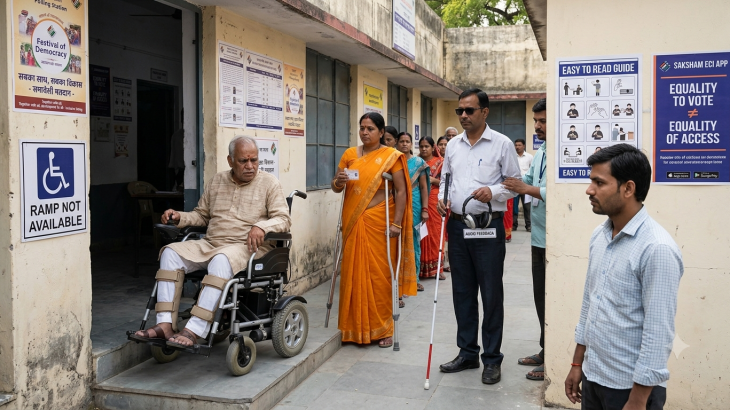
The author of this essay is Apoorva Singh (3rd year student from University of Petroleum and Energy Studies, Dehradun). ADR collaborated with the Centre for Human Rights and Disability Studies (CHRDS), Himachal Pradesh National Law University, Shimla, for the National Article Writing Competition on “Electoral Rights of Persons with Disabilities”. This essay has been published under this collaboration. This essay won the third prize.
ABSTRACT
India gives the right to vote to every adult under Article 326 of the Indian Constitution, but people with disabilities still face so many difficulties while using this right. Even though the UNCRPD and the Rights of Persons with Disabilities Act of 2016 mandate accessible elections, polling places, policies, and attitudes are nevertheless often inhospitable to voters with disabilities. This Article Examines the Gaps of people with disabilities in the politics, the gap in election laws, poor implication of election commission guidelines and the limited support from the Courts. It also argues that accessibility should be viewed as legal right rather than charity and it also suggests strong laws, better accountability, and active involvement of people with disabilities in electoral reforms.
Keywords: Electoral rights, persons with disabilities, accessibility, RPwD Act 2016, UNCRPD, Election Commission of India, inclusive democracy
Introduction
India stands as the world’s largest democratic nation because its citizens hold voting rights, where voting means power for all. Yet for millions of people with disabilities (PwDs), it feels out of reach. Raju, who uses a wheelchair, faces difficulties when he tries to reach a polling station through a muddy path which lacks both ramps and toilets. Article 326 provides voting rights to all adult citizens yet 2.68 crore PwDs from the 2011 Census remain unregistered to vote because they face barriers to voting.
This article establishes and makes a clear point that the legal voting right does not provide citizens with the actual voting access they need to participate in elections. The Representation of the People Acts (1950/51) establish fundamental voting rights but they fail to provide the essential physical and informational and technological assistance which the RPwD Act 2016 (section 7) and UNCRPD Article 29 mandate. This gap treats PwDs as charity cases, not equal citizens, which violates their rights according to Articles 14 and 21.
The article consists of five primary sections. The first part examines legal foundations and missing elements which include outdated “unsound mind” regulations. The second and third parts examine actual accessibility problems which include the absence of ramps at 70% of stations according to ECI 2019 data and the lack of Braille and EVM assistance devices. The fourth point establishes that PwDs face obstacles which prevent them from obtaining office positions. The fifth point states that courts and policies require improvements through implementation of audits and acquisition of advanced equipment and establishment of quotas.
Democracy needs complete voting rights to function properly. The Indian system does not support people with disabilities. This document uses legal and factual evidence to demand changes before the elections which will take place in 2029.
Doctrinal Foundations And Gaps
The electoral laws of India deliver universal voting rights to all adult citizens according to Article 326 of the Constitution, which mandates that Parliament and State Legislature elections should use adult voting rights as the basis for their electoral processes. The constitutional requirement receives implementation through the systems established by the Representation of the People Act, 1950 (RP Act 1950) and Representation of the People Act, 1951 (RP Act 1951). The RP Act 1951 Section 62 gives every person on the electoral roll the right to vote, with the exception of persons who face disqualifications. The voting rights provisions establish a formal voting entitlement through which they provide limited voting access to persons with disabilities (PwDs). The fundamental doctrinal gap appears between this framework assessment and India’s international and domestic disability rights obligations. The UN Convention on the Rights of Persons with Disabilities (UNCRPD) Article 29 requires India to provide “accessible voting procedures, facilities and materials” which enable voters to maintain their privacy while voting and make independent choices. The Rights of Persons with Disabilities Act 2016 (RPwD Act) Section 7 establishes voting rights for persons with disabilities (PwDs) in India as an enabling provision which lacks the status of an enforceable electoral right protected under RP Acts. The current framework allows accessibility to exist as a policy goal while it denies people the right to use this accessibility as a legal claim. The disqualification rules specified in Section 16 of the RP Act 1950 create permanent exclusion through their use of outdated language. The law specifies that electoral rolls must exclude all individuals who have been declared as having “unsound mind” because this term employs a medical definition that does not consider individual capacity assessments. The legal system interprets this requirement in a restricted manner because it needs court-recognized lunacy to establish legal competency yet the law continues to impose its paternalistic mindset which particularly affects people with psychosocial and intellectual disabilities. The election process for persons with disabilities (PwDs) lacks equivalent protective measures because Form 2A/2B nomination papers do not include disability-support options which results in treating PwDs as people who need to prove their abilities.
The doctrinal framework demonstrates the thesis through its demonstration of formal suffrage which fails to function properly because there are no accessibility requirements. The reading of RPwD Act and UNCRPD through Article 326 needs Articles 14 and 21 to prove that people with disabilities have not been given proper recognition of their rights.
Physical And Procedural Barriers
People with disabilities face challenges at polling places which act as inaccessible voting areas despite their right to vote. The Election Commission of India (ECI) reported in 2019 that over 70% of polling stations lacked ramps, accessible toilets, or priority queues which wheelchair users and visually impaired people and those with mobility impairments required to access voting. Rural PwDs face compounded hardship because many voting stations operate at distant locations which require people to travel through unpaved paths thus making disability rights into extreme physical challenges. Activists recorded wheelchair users during the 2024 Lok Sabha elections who crawled up steps and waited for hours in disorganized lines without receiving any help. Voter registration and voting turnout rates show dismal results because these obstacles block people from participating. The 2011 Census of India recorded 2.68 crore persons with disabilities yet electoral commission data shows only half of eligible PwDs registered to vote while some states recorded less than 30% voting turnout. The Right to Information (RTI) responses show polling officials lack training because companion assistance violates voter privacy and Braille signs do not exist to support blind voters. Women with disabilities face double discrimination because they lack dedicated facilities and face obstacles from cultural traditions.
| Barrier | Data/Example | Impact |
| No ramps/toilets | ECI 2019: 70%+ stations inaccessible21 | Wheelchair users abstain; rural exclusion |
| Queue chaos/distances | 50% eligible PwDs unregistered22 | Franchise nullified for 1.3+ crore |
| Untrained staff | RTI data: 60% lack disability training | Secrecy compromised; dependency |
The election commission of India established its “accessible elections” guidelines in 2024 which show model booths implementation because only 10 percent of polling stations meet all requirements according to activist evaluations. The government demonstrates its paternalistic attitude through three voting procedures which lack proper voter transport services and home voting options for disabled people who cannot leave their beds and home voting services which have been available since 2019 yet remain mostly unused. The right to vote disappears through these failures which block access to voting for disabled people because they demonstrate that voting without proper support systems cannot exist in reality.
Informational And Technological Exclusion
The information deficiency together with technological faults prevents people with disabilities from making informed choices during voting outside of physical polling locations. Voter education materials lists, slips, guides rarely come in Braille, audio, large print, or sign language, leaving visually impaired or deaf PwDs reliant on others. The ECI voter guides contain Braille slip information, but RTI audits revealed less than 20% distribution during the 2024 elections while voters.eci.gov.in lacked multi-modal CAPTCHAs which prevented screen-reader users from registering online. The usage of Electronic Voting Machines (EVMs) serves as the primary demonstration of this particular exclusionary practice. The Braille signage on buttons provides assistance to some users yet the design of narrow compartments prevents wheelchair access and the available tactile feedback fails to enable choice verification because visually impaired voters need assistance from others to check their votes which violates Rule 49-O of the Conduct of Elections Rules. The Print reports: “There is no way of knowing if the assisting person has cast a vote for the intended candidate; not every blind voter reads Braille.” The VVPAT slips fail to provide audio verification which makes ECI’s 2019 Braille dummy sheets impossible to achieve actual independent voting.
People with intellectual disabilities and cognitive disabilities encounter greater difficulties because there are no simplified pictorial ballots and plain-language explanations which would help them to make informed choices. During the 2024 elections the Disability Rights Alliance reported that sign-language videos and audio campaigns were missing while wheelchair-accessible priority queues were either unmarked or blocked by insufficiently wide paths.
| Exclusion | Issue | Consequence |
| No Braille/ audio guides | <20% distributed (RTI 2024) | Dependency on others |
| EVM narrow/ tactile flows | No independent verification | Secrecy violated |
| No pictorial/sign language | Absent for cognitive impairments | Consent Compromised |
The Saksham app of ECI provides promised assistance to users but continues to suffer from operational problems and failure to meet accessibility standards. The technological deficits create a situation where people face barriers to access information because they cannot use the educational resources necessary for voting.
CANDIDATE-SIDE DISABILITY REGIME
The electoral system totally prevents people with disabilities (PwDs) from competing in elections while some effort exists to improve voter access. The nomination forms 2A/2B and Form 26 affidavits do not contain any section for disabled candidates to show their disability status which makes them unnoticeable from the beginning. IDR reports that The Election Commission of India does not provide a specific column in either document to capture the disability status of candidates.
The process for filing nominations creates another obstacle for candidates to overcome. The majority of centers operate from upper floors which lack ramps, rendering them inaccessible to
wheelchair users. The organization does not provide Braille or large print documents which blind candidates need to complete their applications. The state laws create additional challenges because the Tamil Nadu Panchayats Act disqualified “deaf-mute” candidates until someone filed a legal challenge and Andhra Pradesh prohibits leprosy-affected individuals from voting even though the disease can be cured.
The “unsound mind” clause of RP Act 1950 Section 16 creates social stigma for people with psychosocial and intellectual disabilities because it determines their mental capacity through an automatic judgment of incompetence. The campaign requires support because it lacks signlanguage interpreters and accessible vehicles and needs additional funding to acquire assistive technology. Independent candidates with disabilities cannot match the electoral power of politicians who have party support.
The data indicates that no People with Disabilities MPs participated in the 2014, 2019, and 2024 Lok Sabha elections. Local bodies have under 0.5% PwD representation despite 2.2% population share.
| Barrier | Specific Issue | Impact |
| Nomination forms | No disability column | Statistical invisibility |
| State laws | Deaf-mute”/leprosy bans | Direct disqualification |
| Campaign support | No interpreters/transport | Can’t compete |
| Representation | 0% Parliament | No political voice |
Judicial, Policy, And Reform Pathways
The Indian courts have maintained their practice of applying a hands-off method to electoral exclusion of persons with disabilities which they treat as administrative issues instead of fundamental rights violations. The Delhi High Court in NCPCR v. ECI (2019) ordered Braille signs to appear on EVMs and priority queues but denied the creation of a complete “access to vote” framework which would operate under Articles 14 and 21 by giving the Election Commission power to decide. The case of PUCL v. UOI (2013) established voting as a constitutional right which protects human dignity but it did not address the need for disability access, such as ramps and tactile EVMs. The justices view these matters as ECI policy shortcomings which lack equality violations that require strict examination. No legal decision has yet established that RPwD Act §7 and UNCRPD Article 29 create enforceable rights which extend Article 326’s voting rights. This judicial minimalism which focuses on electoral processes instead of actual equality rights results in an absence of solutions for persons with disabilities while existing legal principles remain stagnant.
The language of policy efforts fails to produce results because it exists solely as aspirational statements. The ECI 2024 Accessible Elections Compendium presents ramps and Braille slips and Saksham app and companion assistance as elements which expand upon 2019 National Consultations. The RTI responses show terrible implementation results because only 10 to 15 percent of polling stations meet all requirements while rural areas experience worse compliance issues. The home voting service for PwDs and seniors which started in 2019 provides services to less than 5 percent of eligible users because of untrained staff and complex forms and social stigma. The political parties receive voluntary guidelines to create inclusive campaigns but the guidelines do not provide any solutions for PwD candidates because they lack requirements for sign-language rallies and accessible manifestos. The Model Code of Conduct provides no information about disability equity. The ECI approach operates as a symbol rather than a real change because it conducts consultations which produce advisory results that lack specific implementation details. The policy transforms into a photo-opportunity compliance method which creates an environment where people face no consequences for their actions.34
Global models demonstrate that India has fallen behind other countries. Canada uses audio-EVMs which include headphone verification and tactile templates to permit blind voters to make their choices independently. Australia requires all organizations to conduct accessibility audits which will result in penalties of up to AUD 20,000 for non-compliant stations. Germany enables voters to cast their ballots through proxy voting while home delivery kits provide everything needed to vote from home. The jurisdictions implement CRPD Article 29 through universal design which provides services that all people can access instead of developing special features for people with disabilities which India follows through its charity model.
Concrete reforms are overdue across doctrinal, legislative, and institutional fronts:
The Doctrinal Shift: requires courts to interpret Article 326 through the combination of RPwD Act section 7 and UNCRPD Article 29 which establishes enforceable access rights that function like privacy laws. The strict scrutiny standard should be applied to all barriers which disable individuals from accessing services.
Legislative Fixes: The RP Act 1950 needs amendment through its section 16 to replace “unsound mind” with individual capacity assessments which should be evaluated through disability-status columns that need to be added to Forms 2A and 26. The state disqualifiers which include the Tamil Nadu “deaf-mute” ban and the Andhra leprosy rule need to be repealed. The RPwD Act section 11[2] accessibility requirements need to be applied to all processes which people use to become candidates.
Institutional Mandates: The ECI will perform electoral access audits before elections which will result in public report and compliance penalty for any violations that fall below 90% compliance standards. The ECI will require political parties to maintain a 1% electoral quota for candidates with disabilities according to their recognized status. The ECI will require polling staff to complete mandatory training modules which will apply to all staff members. The election budget should allocate 0.5% of total funds to support assistive technology needs. Technological Upgrades: The project requires the implementation of audio-verified VVPATs which need to deliver sound through earphones. The project requires the implementation of Braille and large-print nomination forms. The project needs to create sign-language voter education videos which will be distributed through various platforms. The system will provide online portals which support voice and Braille accessibility.
These linked pathways lead people with disabilities to become disability rights leaders who establish democratic systems. The 2029 elections will repeat their previous pattern of exclusion without judicial power and enforceable policies and strong laws. The three institutions of Parliament and the courts and the Election Commission of India together create a system that denies voting rights to people who cannot access polling places which disrespects the fundamental values of the Indian Constitution. The current situation needs immediate change because 2.68 crore citizens will lose their democratic rights.
Conclusion
India grants citizens a formal “right to vote” through Article 326[1] of its electoral laws.However, people with disabilities (PwDs) encounter multiple barriers which include physical access limitations and informational access restrictions and technological access challenges and limitations on their ability to participate in elections. The current system violates RPwD Act 2016[2] and UNCRPD Article 29[3] through its denial of access to nomination materials and judicial processes in addition to its Braille-deficient EVMs and ramp-less stations. The system prevents
2.68 crore PwDs from active democratic participation through their treatment as spectators.
The situation demands immediate reforms which require reading accessibility rights into Articles 14 and 21. Reforms should require the Election Commission of India to conduct audits while implementing accessible electronic voting machines and establishing voting rights for persons with disabilities. The upcoming election period should replace current suffrage systems with real voter rights which will empower people with disabilities to become political decision-makers. Real democratic systems require both rights to exist together as essential elements of democratic governance.